
文章目录
- 可以使用 pip 获取最新资源: pip install skope-rules
- SkopeRules 可用于描述具有逻辑规则的类:
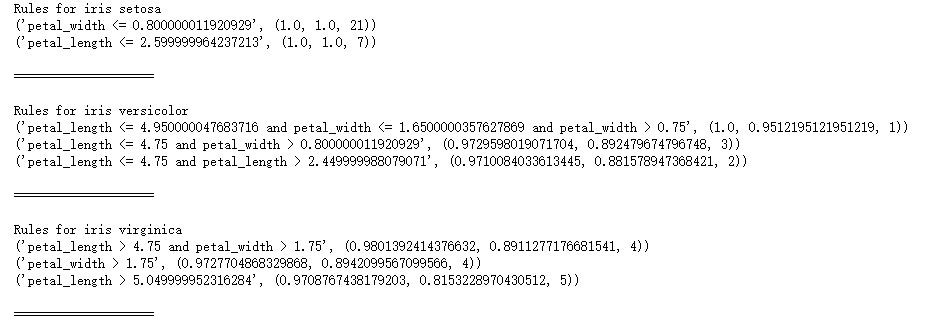
from sklearn.datasets import load_irisfrom skrules import SkopeRulesdataset = load_iris()feature_names = ['sepal_length', 'sepal_width', 'petal_length', 'petal_width']clf = SkopeRules(max_depth_duplicatinotallow=2, n_estimators=30, precision_min=0.3, recall_min=0.1, feature_names=feature_names)for idx, species in enumerate(dataset.target_names): X, y = dataset.data, dataset.target clf.fit(X, y == idx) rules = clf.rules_[0:3] print("Rules for iris", species) for rule in rules: print(rule) print() print(20*'=') print()
- 如果出现如下错误:
- 关于 Python 导入错误 : cannot import name 'six' from 'sklearn.externals' ,云朵君在Stack Overflow上找到一个类似的问题:https://stackoverflow.com/questions/61867945/ 解决方案如下 import siximport syssys.modules['sklearn.externals.six'] = siximport mlrose
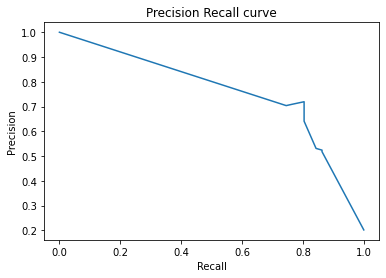
- 如果使用“score_top_rules”方法,SkopeRules 也可以用作预测器: from sklearn.datasets import load_bostonfrom sklearn.metrics import precision_recall_curvefrom matplotlib import pyplot as pltfrom skrules import SkopeRulesdataset = load_boston()clf = SkopeRules(max_depth_duplicatinotallow=None, n_estimators=30, precision_min=0.2, recall_min=0.01, feature_names=dataset.feature_names)X, y = dataset.data, dataset.target > 25X_train, y_train = X[:len(y)//2], y[:len(y)//2]X_test, y_test = X[len(y)//2:], y[len(y)//2:]clf.fit(X_train, y_train)y_score = clf.score_top_rules(X_test) # Get a risk score for each test exampleprecision, recall, _ = precision_recall_curve(y_test, y_score)plt.plot(recall, precision)plt.xlabel('Recall')plt.ylabel('Precision')plt.title('Precision Recall curve')plt.show()
- 导入相关库 数据准备 模型训练(使用ScopeRules().score_top_rules()方法) 解释 "生存规则"(使用SkopeRules().rules_属性)。 性能分析(使用SkopeRules.predict_top_rules()方法)。
- # Import skope-rulesfrom skrules import SkopeRules# Import librairiesimport pandas as pdfrom sklearn.ensemble import GradientBoostingClassifier, RandomForestClassifierfrom sklearn.model_selection import train_test_splitfrom sklearn.tree import DecisionTreeClassifierimport matplotlib.pyplot as pltfrom sklearn.metrics import roc_curve, precision_recall_curvefrom matplotlib import cmimport numpy as npfrom sklearn.metrics import confusion_matrixfrom IPython.display import display# Import Titanic datadata = pd.read_csv('../data/titanic-train.csv')
- # 删除年龄缺失的行data = data.query('Age == Age')# 为变量Sex创建编码值data['isFemale'] = (data['Sex'] == 'female') * 1# 未变量Embarked创建编码值data = pd.concat( [data, pd.get_dummies(data.loc[:,'Embarked'], dummy_na=False, prefix='Embarked', prefix_sep='_')], axis=1)# 删除没有使用的变量data = data.drop(['Name', 'Ticket', 'Cabin', 'PassengerId', 'Sex', 'Embarked'], axis = 1)# 创建训练及测试集X_train, X_test, y_train, y_test = train_test_split( data.drop(['Survived'], axis=1), data['Survived'], test_size=0.25, random_state=42)feature_names = X_train.columnsprint('Column names are: ' + ' '.join(feature_names.tolist())+'.')print('Shape of training set is: ' + str(X_train.shape) + '.') Column names are: Pclass Age SibSp Parch FareisFemale Embarked_C Embarked_Q Embarked_S.Shape of training set is: (535, 9).
- # 训练一个梯度提升分类器,用于基准测试gradient_boost_clf = GradientBoostingClassifier(random_state=42, n_estimators=30, max_depth = 5)gradient_boost_clf.fit(X_train, y_train)# 训练一个随机森林分类器,用于基准测试random_forest_clf = RandomForestClassifier(random_state=42, n_estimators=30, max_depth = 5)random_forest_clf.fit(X_train, y_train)# 训练一个决策树分类器,用于基准测试decision_tree_clf = DecisionTreeClassifier(random_state=42, max_depth = 5)decision_tree_clf.fit(X_train, y_train)# 训练一个 skope-rules-boosting 分类器skope_rules_clf = SkopeRules(feature_names=feature_names, random_state=42, n_estimators=30, recall_min=0.05, precision_min=0.9, max_samples=0.7, max_depth_duplicatinotallow= 4, max_depth = 5)skope_rules_clf.fit(X_train, y_train)# 计算预测分数gradient_boost_scoring = gradient_boost_clf.predict_proba(X_test)[:, 1]random_forest_scoring = random_forest_clf.predict_proba(X_test)[:, 1]decision_tree_scoring = decision_tree_clf.predict_proba(X_test)[:, 1]skope_rules_scoring = skope_rules_clf.score_top_rules(X_test)
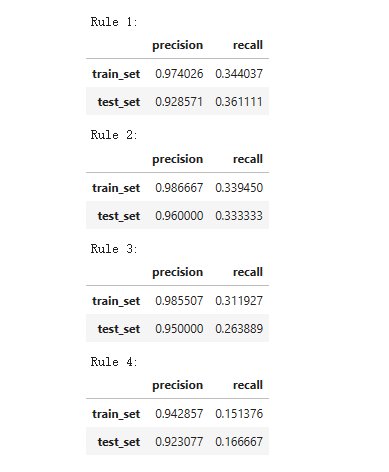
- # 获得创建的生存规则的数量print("用SkopeRules建立了" + str(len(skope_rules_clf.rules_)) + "条规则\n")# 打印这些规则rules_explanations = [ "3岁以下和37岁以下,在头等舱或二等舱的女性。" "3岁以上乘坐头等舱或二等舱,支付超过26欧元的女性。" "坐一等舱或二等舱,支付超过29欧元的女性。" "年龄在39岁以上,在头等舱或二等舱的女性。"]print('其中表现最好的4条 "泰坦尼克号生存规则" 如下所示:/n')for i_rule, rule in enumerate(skope_rules_clf.rules_[:4]) print(rule[0]) print('->'+rules_explanations[i_rule]+ '\n') 用SkopeRules建立了9条规则。其中表现最好的4条 "泰坦尼克号生存规则" 如下所示:Age <= 37.0 and Age > 2.5 and Pclass <= 2.5 and isFemale > 0.5 -> 3岁以下和37岁以下,在头等舱或二等舱的女性。Age > 2.5 and Fare > 26.125 and Pclass <= 2.5 and isFemale > 0.5 -> 3岁以上乘坐头等舱或二等舱,支付超过26欧元的女性。Fare > 29.356250762939453 and Pclass <= 2.5 and isFemale > 0.5 -> 坐一等舱或二等舱,支付超过29欧元的女性。Age > 38.5 and Pclass <= 2.5 and isFemale > 0.5 -> 年龄在39岁以上,在头等舱或二等舱的女性。 def compute_y_pred_from_query(X, rule): score = np.zeros(X.shape[0]) X = X.reset_index(drop=True) score[list(X.query(rule).index)] = 1 return(score)def compute_performances_from_y_pred(y_true, y_pred, index_name='default_index'): df = pd.DataFrame(data= { 'precision':[sum(y_true * y_pred)/sum(y_pred)], 'recall':[sum(y_true * y_pred)/sum(y_true)] }, index=[index_name], columns=['precision', 'recall'] ) return(df)def compute_train_test_query_performances(X_train, y_train, X_test, y_test, rule): y_train_pred = compute_y_pred_from_query(X_train, rule) y_test_pred = compute_y_pred_from_query(X_test, rule) performances = None performances = pd.concat([ performances, compute_performances_from_y_pred(y_train, y_train_pred, 'train_set')], axis=0) performances = pd.concat([ performances, compute_performances_from_y_pred(y_test, y_test_pred, 'test_set')], axis=0) return(performances)print('Precision = 0.96 表示规则确定的96%的人是幸存者。')print('Recall = 0.12 表示规则识别的幸存者占幸存者总数的12%\n')for i in range(4): print('Rule '+str(i+1)+':') display(compute_train_test_query_performances(X_train, y_train, X_test, y_test, skope_rules_clf.rules_[i][0]) ) Precision = 0.96 表示规则确定的96%的人是幸存者。Recall = 0.12 表示规则识别的幸存者占幸存者总数的12%。
- def plot_titanic_scores(y_true, scores_with_line=[], scores_with_points=[], labels_with_line=['Gradient Boosting', 'Random Forest', 'Decision Tree'], labels_with_points=['skope-rules']): gradient = np.linspace(0, 1, 10) color_list = [ cm.tab10(x) for x in gradient ] fig, axes = plt.subplots(1, 2, figsize=(12, 5), sharex=True, sharey=True) ax = axes[0] n_line = 0 for i_score, score in enumerate(scores_with_line): n_line = n_line + 1 fpr, tpr, _ = roc_curve(y_true, score) ax.plot(fpr, tpr, linestyle='-.', c=color_list[i_score], lw=1, label=labels_with_line[i_score]) for i_score, score in enumerate(scores_with_points): fpr, tpr, _ = roc_curve(y_true, score) ax.scatter(fpr[:-1], tpr[:-1], c=color_list[n_line + i_score], s=10, label=labels_with_points[i_score]) ax.set_title("ROC", fnotallow=20) ax.set_xlabel('False Positive Rate', fnotallow=18) ax.set_ylabel('True Positive Rate (Recall)', fnotallow=18) ax.legend(loc='lower center', fnotallow=8) ax = axes[1] n_line = 0 for i_score, score in enumerate(scores_with_line): n_line = n_line + 1 precision, recall, _ = precision_recall_curve(y_true, score) ax.step(recall, precision, linestyle='-.', c=color_list[i_score], lw=1, where='post', label=labels_with_line[i_score]) for i_score, score in enumerate(scores_with_points): precision, recall, _ = precision_recall_curve(y_true, score) ax.scatter(recall, precision, c=color_list[n_line + i_score], s=10, label=labels_with_points[i_score]) ax.set_title("Precision-Recall", fnotallow=20) ax.set_xlabel('Recall (True Positive Rate)', fnotallow=18) ax.set_ylabel('Precision', fnotallow=18) ax.legend(loc='lower center', fnotallow=8) plt.show() plot_titanic_scores(y_test, scores_with_line=[gradient_boost_scoring, random_forest_scoring, decision_tree_scoring], scores_with_points=[skope_rules_scoring] ) 在ROC曲线上,每个红点对应于激活的规则(来自skope-rules)的数量。例如,最低点是1个规则(最好的)的结果点。第二低点是2条规则结果点,等等。 在准确率-召回率曲线上,同样的点是用不同的坐标轴绘制的。警告:左边的第一个红点(0%召回率,100%精度)对应于0条规则。左边的第二个点是第一个规则,等等。 从这个例子可以得出一些结论。 skope-rules的表现比决策树好。 skope-rules的性能与随机森林/梯度提升相似(在这个例子中)。 使用4个规则可以获得很好的性能(61%的召回率,94%的精确度)(在这个例子中)。 n_rule_chosen = 4y_pred = skope_rules_clf.predict_top_rules(X_test, n_rule_chosen)print('The performances reached with '+str(n_rule_chosen)+' discovered rules are the following:')compute_performances_from_y_pred(y_test, y_pred, 'test_set') predict_top_rules(new_data, n_r)方法用来计算对new_data的预测,其中有前n_r条skope-rules规则。
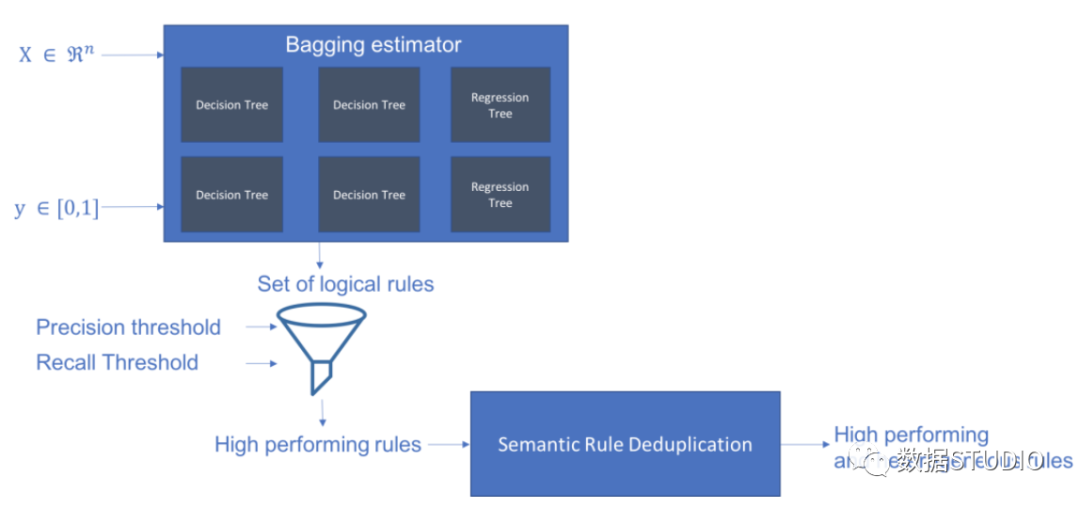
Skope-rules使用树模型生成规则候选项。首先建立一些决策树,并将从根节点到内部节点或叶子节点的路径视为规则候选项。然后通过一些预定义的标准(如精确度和召回率)对这些候选规则进行过滤。只有那些精确度和召回率高于其阈值的才会被保留。最后,应用相似性过滤来选择具有足够多样性的规则。一般情况下,应用Skope-rules来学习每个根本原因的潜在规则。
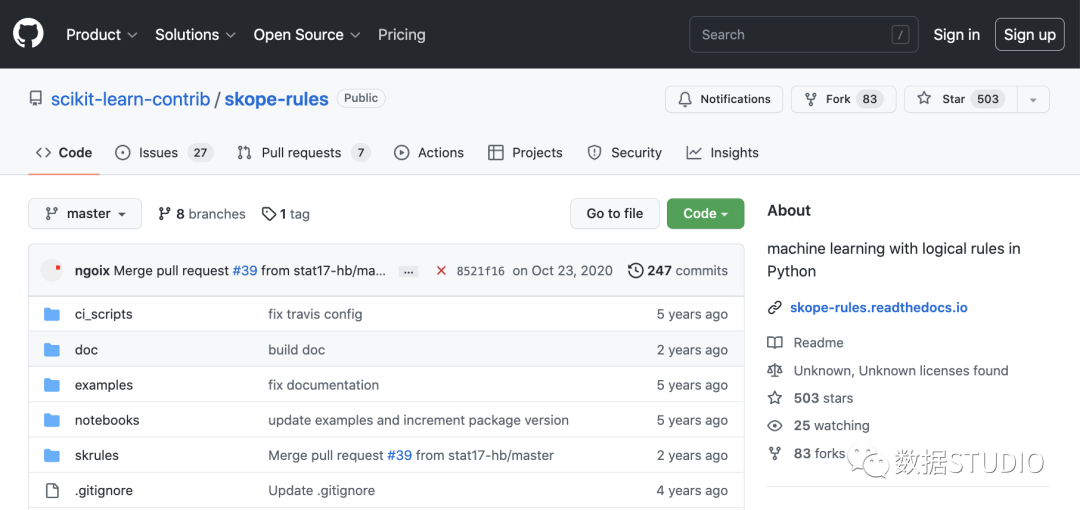
项目地址:https://github.com/scikit-learn-contrib/skope-rules
- Skope-rules是一个建立在scikit-learn之上的Python机器学习模块,在3条款BSD许可下发布。
- Skope-rules旨在学习逻辑的、可解释的规则,用于 "界定 "目标类别,即高精度地检测该类别的实例。
- Skope-rules是决策树的可解释性和随机森林的建模能力之间的一种权衡。
schema
可以使用 pip 获取最新资源:
pip install skope-rules
SkopeRules 可用于描述具有逻辑规则的类:
from sklearn.datasets import load_iris
from skrules import SkopeRules

dataset = load_iris()
feature_names = ['sepal_length', 'sepal_width', 'petal_length', 'petal_width']
clf = SkopeRules(max_depth_duplicatinotallow=2,
 n_estimators=30,
 precision_min=0.3,
 recall_min=0.1,
 feature_names=feature_names)

for idx, species in enumerate(dataset.target_names):
 X, y = dataset.data, dataset.target
 clf.fit(X, y == idx)
 rules = clf.rules_[0:3]
 print("Rules for iris", species)
 for rule in rules:
 print(rule)
 print()
 print(20*'=')
 print()
如果出现如下错误:
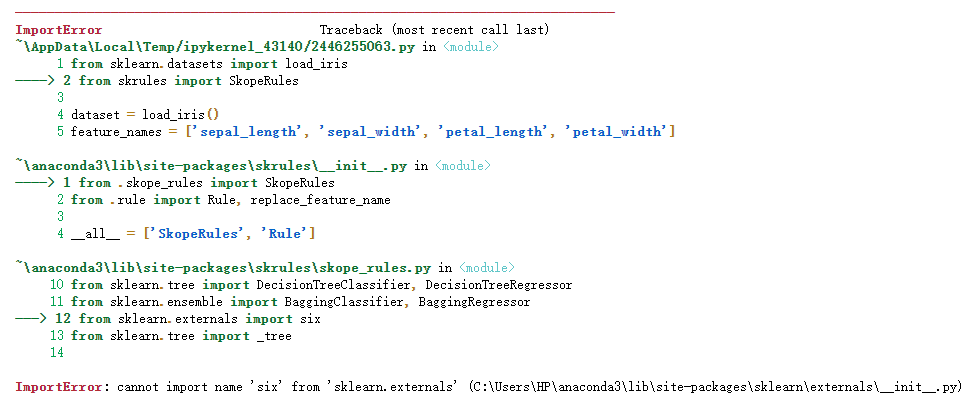
关于 Python 导入错误 : cannot import name 'six' from 'sklearn.externals' ,云朵君在Stack Overflow上找到一个类似的问题:https://stackoverflow.com/questions/61867945/
解决方案如下
import six
import sys
sys.modules['sklearn.externals.six'] = six
import mlrose
如果使用“score_top_rules”方法,SkopeRules 也可以用作预测器:
from sklearn.datasets import load_boston
from sklearn.metrics import precision_recall_curve
from matplotlib import pyplot as plt
from skrules import SkopeRules

dataset = load_boston()
clf = SkopeRules(max_depth_duplicatinotallow=None,
 n_estimators=30,
 precision_min=0.2,
 recall_min=0.01,
 feature_names=dataset.feature_names)

X, y = dataset.data, dataset.target > 25
X_train, y_train = X[:len(y)//2], y[:len(y)//2]
X_test, y_test = X[len(y)//2:], y[len(y)//2:]
clf.fit(X_train, y_train)
y_score = clf.score_top_rules(X_test) # Get a risk score for each test example
precision, recall, _ = precision_recall_curve(y_test, y_score)
plt.plot(recall, precision)
plt.xlabel('Recall')
plt.ylabel('Precision')
plt.title('Precision Recall curve')
plt.show()
本案例展示了在著名的泰坦尼克号数据集上使用skope-rules。
skope-rules适用情况:
- 解决二分类问题
- 提取可解释的决策规则
- 导入相关库
- 数据准备
- 模型训练(使用ScopeRules().score_top_rules()方法)
- 解释 "生存规则"(使用SkopeRules().rules_属性)。
- 性能分析(使用SkopeRules.predict_top_rules()方法)。
# Import skope-rules
from skrules import SkopeRules

# Import librairies
import pandas as pd
from sklearn.ensemble import GradientBoostingClassifier, RandomForestClassifier
from sklearn.model_selection import train_test_split
from sklearn.tree import DecisionTreeClassifier
import matplotlib.pyplot as plt
from sklearn.metrics import roc_curve, precision_recall_curve
from matplotlib import cm
import numpy as np
from sklearn.metrics import confusion_matrix
from IPython.display import display

# Import Titanic data
data = pd.read_csv('../data/titanic-train.csv')
from skrules import SkopeRules
# Import librairies
import pandas as pd
from sklearn.ensemble import GradientBoostingClassifier, RandomForestClassifier
from sklearn.model_selection import train_test_split
from sklearn.tree import DecisionTreeClassifier
import matplotlib.pyplot as plt
from sklearn.metrics import roc_curve, precision_recall_curve
from matplotlib import cm
import numpy as np
from sklearn.metrics import confusion_matrix
from IPython.display import display
# Import Titanic data
data = pd.read_csv('../data/titanic-train.csv')
# 删除年龄缺失的行
data = data.query('Age == Age')
# 为变量Sex创建编码值
data['isFemale'] = (data['Sex'] == 'female') * 1
# 未变量Embarked创建编码值
data = pd.concat(
 [data,
 pd.get_dummies(data.loc[:,'Embarked'],
 dummy_na=False,
 prefix='Embarked',
 prefix_sep='_')],
 axis=1
)
# 删除没有使用的变量
data = data.drop(['Name', 'Ticket', 'Cabin',
 'PassengerId', 'Sex', 'Embarked'],
 axis = 1)
# 创建训练及测试集
X_train, X_test, y_train, y_test = train_test_split(
 data.drop(['Survived'], axis=1),
 data['Survived'],
 test_size=0.25, random_state=42)
feature_names = X_train.columns

print('Column names are: ' + ' '.join(feature_names.tolist())+'.')
print('Shape of training set is: ' + str(X_train.shape) + '.')
Column names are: Pclass Age SibSp Parch Fare
isFemale Embarked_C Embarked_Q Embarked_S.
Shape of training set is: (535, 9).
data = data.query('Age == Age')
# 为变量Sex创建编码值
data['isFemale'] = (data['Sex'] == 'female') * 1
# 未变量Embarked创建编码值
data = pd.concat(
[data,
pd.get_dummies(data.loc[:,'Embarked'],
dummy_na=False,
prefix='Embarked',
prefix_sep='_')],
axis=1
)
# 删除没有使用的变量
data = data.drop(['Name', 'Ticket', 'Cabin',
'PassengerId', 'Sex', 'Embarked'],
axis = 1)
# 创建训练及测试集
X_train, X_test, y_train, y_test = train_test_split(
data.drop(['Survived'], axis=1),
data['Survived'],
test_size=0.25, random_state=42)
feature_names = X_train.columns
print('Column names are: ' + ' '.join(feature_names.tolist())+'.')
print('Shape of training set is: ' + str(X_train.shape) + '.')
isFemale Embarked_C Embarked_Q Embarked_S.
Shape of training set is: (535, 9).
# 训练一个梯度提升分类器,用于基准测试
gradient_boost_clf = GradientBoostingClassifier(random_state=42, n_estimators=30, max_depth = 5)
gradient_boost_clf.fit(X_train, y_train)

# 训练一个随机森林分类器,用于基准测试
random_forest_clf = RandomForestClassifier(random_state=42, n_estimators=30, max_depth = 5)
random_forest_clf.fit(X_train, y_train)

# 训练一个决策树分类器,用于基准测试
decision_tree_clf = DecisionTreeClassifier(random_state=42, max_depth = 5)
decision_tree_clf.fit(X_train, y_train)

# 训练一个 skope-rules-boosting 分类器
skope_rules_clf = SkopeRules(feature_names=feature_names, random_state=42, n_estimators=30,
 recall_min=0.05, precision_min=0.9,
 max_samples=0.7,
 max_depth_duplicatinotallow= 4, max_depth = 5)
skope_rules_clf.fit(X_train, y_train)


# 计算预测分数
gradient_boost_scoring = gradient_boost_clf.predict_proba(X_test)[:, 1]
random_forest_scoring = random_forest_clf.predict_proba(X_test)[:, 1]
decision_tree_scoring = decision_tree_clf.predict_proba(X_test)[:, 1]

skope_rules_scoring = skope_rules_clf.score_top_rules(X_test)
gradient_boost_clf = GradientBoostingClassifier(random_state=42, n_estimators=30, max_depth = 5)
gradient_boost_clf.fit(X_train, y_train)
# 训练一个随机森林分类器,用于基准测试
random_forest_clf = RandomForestClassifier(random_state=42, n_estimators=30, max_depth = 5)
random_forest_clf.fit(X_train, y_train)
# 训练一个决策树分类器,用于基准测试
decision_tree_clf = DecisionTreeClassifier(random_state=42, max_depth = 5)
decision_tree_clf.fit(X_train, y_train)
# 训练一个 skope-rules-boosting 分类器
skope_rules_clf = SkopeRules(feature_names=feature_names, random_state=42, n_estimators=30,
recall_min=0.05, precision_min=0.9,
max_samples=0.7,
max_depth_duplicatinotallow= 4, max_depth = 5)
skope_rules_clf.fit(X_train, y_train)
# 计算预测分数
gradient_boost_scoring = gradient_boost_clf.predict_proba(X_test)[:, 1]
random_forest_scoring = random_forest_clf.predict_proba(X_test)[:, 1]
decision_tree_scoring = decision_tree_clf.predict_proba(X_test)[:, 1]
skope_rules_scoring = skope_rules_clf.score_top_rules(X_test)
# 获得创建的生存规则的数量
print("用SkopeRules建立了" + str(len(skope_rules_clf.rules_)) + "条规则\n")

# 打印这些规则
rules_explanations = [
 "3岁以下和37岁以下,在头等舱或二等舱的女性。"
 "3岁以上乘坐头等舱或二等舱,支付超过26欧元的女性。"
 "坐一等舱或二等舱,支付超过29欧元的女性。"
 "年龄在39岁以上,在头等舱或二等舱的女性。"
]
print('其中表现最好的4条 "泰坦尼克号生存规则" 如下所示:/n')
for i_rule, rule in enumerate(skope_rules_clf.rules_[:4])
 print(rule[0])
 print('->'+rules_explanations[i_rule]+ '\n')
用SkopeRules建立了9条规则。

其中表现最好的4条 "泰坦尼克号生存规则" 如下所示:

Age <= 37.0 and Age > 2.5
and Pclass <= 2.5 and isFemale > 0.5
-> 3岁以下和37岁以下,在头等舱或二等舱的女性。

Age > 2.5 and Fare > 26.125
and Pclass <= 2.5 and isFemale > 0.5
-> 3岁以上乘坐头等舱或二等舱,支付超过26欧元的女性。

Fare > 29.356250762939453
and Pclass <= 2.5 and isFemale > 0.5
-> 坐一等舱或二等舱,支付超过29欧元的女性。

Age > 38.5 and Pclass <= 2.5
and isFemale > 0.5
-> 年龄在39岁以上,在头等舱或二等舱的女性。
def compute_y_pred_from_query(X, rule):
 score = np.zeros(X.shape[0])
 X = X.reset_index(drop=True)
 score[list(X.query(rule).index)] = 1
 return(score)

def compute_performances_from_y_pred(y_true, y_pred, index_name='default_index'):
 df = pd.DataFrame(data=
 {
 'precision':[sum(y_true * y_pred)/sum(y_pred)],
 'recall':[sum(y_true * y_pred)/sum(y_true)]
 },
 index=[index_name],
 columns=['precision', 'recall']
 )
 return(df)

def compute_train_test_query_performances(X_train, y_train, X_test, y_test, rule):

 y_train_pred = compute_y_pred_from_query(X_train, rule)
 y_test_pred = compute_y_pred_from_query(X_test, rule)

 performances = None
 performances = pd.concat([
 performances,
 compute_performances_from_y_pred(y_train, y_train_pred, 'train_set')],
 axis=0)
 performances = pd.concat([
 performances,
 compute_performances_from_y_pred(y_test, y_test_pred, 'test_set')],
 axis=0)

 return(performances)


print('Precision = 0.96 表示规则确定的96%的人是幸存者。')
print('Recall = 0.12 表示规则识别的幸存者占幸存者总数的12%\n')

for i in range(4):
 print('Rule '+str(i+1)+':')
 display(compute_train_test_query_performances(X_train, y_train,
 X_test, y_test,
 skope_rules_clf.rules_[i][0])
 )
Precision = 0.96 表示规则确定的96%的人是幸存者。
Recall = 0.12 表示规则识别的幸存者占幸存者总数的12%。
print("用SkopeRules建立了" + str(len(skope_rules_clf.rules_)) + "条规则\n")
# 打印这些规则
rules_explanations = [
"3岁以下和37岁以下,在头等舱或二等舱的女性。"
"3岁以上乘坐头等舱或二等舱,支付超过26欧元的女性。"
"坐一等舱或二等舱,支付超过29欧元的女性。"
"年龄在39岁以上,在头等舱或二等舱的女性。"
]
print('其中表现最好的4条 "泰坦尼克号生存规则" 如下所示:/n')
for i_rule, rule in enumerate(skope_rules_clf.rules_[:4])
print(rule[0])
print('->'+rules_explanations[i_rule]+ '\n')
其中表现最好的4条 "泰坦尼克号生存规则" 如下所示:
Age <= 37.0 and Age > 2.5
and Pclass <= 2.5 and isFemale > 0.5
-> 3岁以下和37岁以下,在头等舱或二等舱的女性。
Age > 2.5 and Fare > 26.125
and Pclass <= 2.5 and isFemale > 0.5
-> 3岁以上乘坐头等舱或二等舱,支付超过26欧元的女性。
Fare > 29.356250762939453
and Pclass <= 2.5 and isFemale > 0.5
-> 坐一等舱或二等舱,支付超过29欧元的女性。
Age > 38.5 and Pclass <= 2.5
and isFemale > 0.5
-> 年龄在39岁以上,在头等舱或二等舱的女性。
score = np.zeros(X.shape[0])
X = X.reset_index(drop=True)
score[list(X.query(rule).index)] = 1
return(score)
def compute_performances_from_y_pred(y_true, y_pred, index_name='default_index'):
df = pd.DataFrame(data=
{
'precision':[sum(y_true * y_pred)/sum(y_pred)],
'recall':[sum(y_true * y_pred)/sum(y_true)]
},
index=[index_name],
columns=['precision', 'recall']
)
return(df)
def compute_train_test_query_performances(X_train, y_train, X_test, y_test, rule):
y_train_pred = compute_y_pred_from_query(X_train, rule)
y_test_pred = compute_y_pred_from_query(X_test, rule)
performances = None
performances = pd.concat([
performances,
compute_performances_from_y_pred(y_train, y_train_pred, 'train_set')],
axis=0)
performances = pd.concat([
performances,
compute_performances_from_y_pred(y_test, y_test_pred, 'test_set')],
axis=0)
return(performances)
print('Precision = 0.96 表示规则确定的96%的人是幸存者。')
print('Recall = 0.12 表示规则识别的幸存者占幸存者总数的12%\n')
for i in range(4):
print('Rule '+str(i+1)+':')
display(compute_train_test_query_performances(X_train, y_train,
X_test, y_test,
skope_rules_clf.rules_[i][0])
)
Recall = 0.12 表示规则识别的幸存者占幸存者总数的12%。
def plot_titanic_scores(y_true, scores_with_line=[], scores_with_points=[],
 labels_with_line=['Gradient Boosting', 'Random Forest', 'Decision Tree'],
 labels_with_points=['skope-rules']):
 gradient = np.linspace(0, 1, 10)
 color_list = [ cm.tab10(x) for x in gradient ]

 fig, axes = plt.subplots(1, 2, figsize=(12, 5),
 sharex=True, sharey=True)
 ax = axes[0]
 n_line = 0
 for i_score, score in enumerate(scores_with_line):
 n_line = n_line + 1
 fpr, tpr, _ = roc_curve(y_true, score)
 ax.plot(fpr, tpr, linestyle='-.', c=color_list[i_score], lw=1, label=labels_with_line[i_score])
 for i_score, score in enumerate(scores_with_points):
 fpr, tpr, _ = roc_curve(y_true, score)
 ax.scatter(fpr[:-1], tpr[:-1], c=color_list[n_line + i_score], s=10, label=labels_with_points[i_score])
 ax.set_title("ROC", fnotallow=20)
 ax.set_xlabel('False Positive Rate', fnotallow=18)
 ax.set_ylabel('True Positive Rate (Recall)', fnotallow=18)
 ax.legend(loc='lower center', fnotallow=8)

 ax = axes[1]
 n_line = 0
 for i_score, score in enumerate(scores_with_line):
 n_line = n_line + 1
 precision, recall, _ = precision_recall_curve(y_true, score)
 ax.step(recall, precision, linestyle='-.', c=color_list[i_score], lw=1, where='post', label=labels_with_line[i_score])
 for i_score, score in enumerate(scores_with_points):
 precision, recall, _ = precision_recall_curve(y_true, score)
 ax.scatter(recall, precision, c=color_list[n_line + i_score], s=10, label=labels_with_points[i_score])
 ax.set_title("Precision-Recall", fnotallow=20)
 ax.set_xlabel('Recall (True Positive Rate)', fnotallow=18)
 ax.set_ylabel('Precision', fnotallow=18)
 ax.legend(loc='lower center', fnotallow=8)
 plt.show()

plot_titanic_scores(y_test,
 scores_with_line=[gradient_boost_scoring, random_forest_scoring, decision_tree_scoring],
 scores_with_points=[skope_rules_scoring]
 )
labels_with_line=['Gradient Boosting', 'Random Forest', 'Decision Tree'],
labels_with_points=['skope-rules']):
gradient = np.linspace(0, 1, 10)
color_list = [ cm.tab10(x) for x in gradient ]
fig, axes = plt.subplots(1, 2, figsize=(12, 5),
sharex=True, sharey=True)
ax = axes[0]
n_line = 0
for i_score, score in enumerate(scores_with_line):
n_line = n_line + 1
fpr, tpr, _ = roc_curve(y_true, score)
ax.plot(fpr, tpr, linestyle='-.', c=color_list[i_score], lw=1, label=labels_with_line[i_score])
for i_score, score in enumerate(scores_with_points):
fpr, tpr, _ = roc_curve(y_true, score)
ax.scatter(fpr[:-1], tpr[:-1], c=color_list[n_line + i_score], s=10, label=labels_with_points[i_score])
ax.set_title("ROC", fnotallow=20)
ax.set_xlabel('False Positive Rate', fnotallow=18)
ax.set_ylabel('True Positive Rate (Recall)', fnotallow=18)
ax.legend(loc='lower center', fnotallow=8)
ax = axes[1]
n_line = 0
for i_score, score in enumerate(scores_with_line):
n_line = n_line + 1
precision, recall, _ = precision_recall_curve(y_true, score)
ax.step(recall, precision, linestyle='-.', c=color_list[i_score], lw=1, where='post', label=labels_with_line[i_score])
for i_score, score in enumerate(scores_with_points):
precision, recall, _ = precision_recall_curve(y_true, score)
ax.scatter(recall, precision, c=color_list[n_line + i_score], s=10, label=labels_with_points[i_score])
ax.set_title("Precision-Recall", fnotallow=20)
ax.set_xlabel('Recall (True Positive Rate)', fnotallow=18)
ax.set_ylabel('Precision', fnotallow=18)
ax.legend(loc='lower center', fnotallow=8)
plt.show()
plot_titanic_scores(y_test,
scores_with_line=[gradient_boost_scoring, random_forest_scoring, decision_tree_scoring],
scores_with_points=[skope_rules_scoring]
)
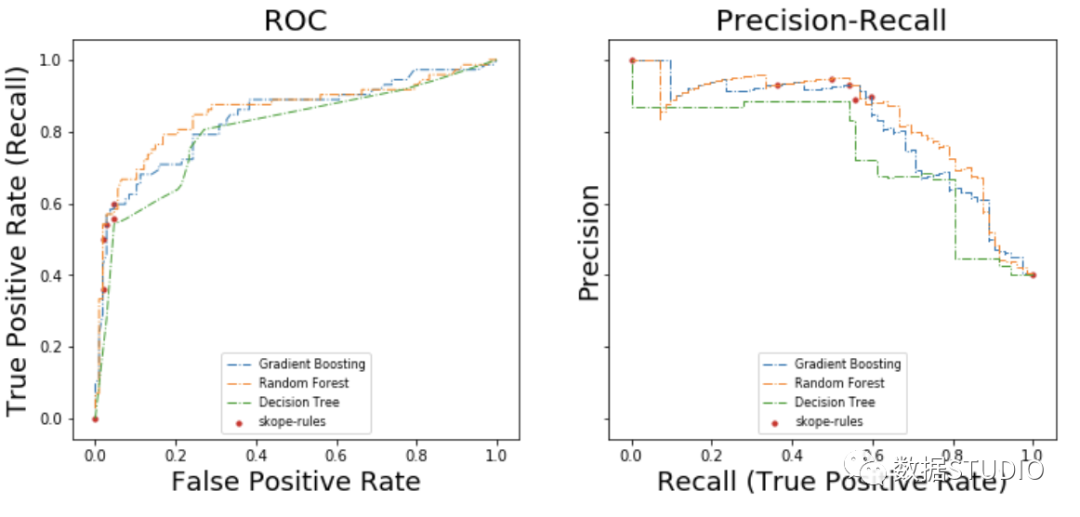
在ROC曲线上,每个红点对应于激活的规则(来自skope-rules)的数量。例如,最低点是1个规则(最好的)的结果点。第二低点是2条规则结果点,等等。
在准确率-召回率曲线上,同样的点是用不同的坐标轴绘制的。警告:左边的第一个红点(0%召回率,100%精度)对应于0条规则。左边的第二个点是第一个规则,等等。
从这个例子可以得出一些结论。
- skope-rules的表现比决策树好。
- skope-rules的性能与随机森林/梯度提升相似(在这个例子中)。
- 使用4个规则可以获得很好的性能(61%的召回率,94%的精确度)(在这个例子中)。
n_rule_chosen = 4
y_pred = skope_rules_clf.predict_top_rules(X_test, n_rule_chosen)

print('The performances reached with '+str(n_rule_chosen)+' discovered rules are the following:')
compute_performances_from_y_pred(y_test, y_pred, 'test_set')

predict_top_rules(new_data, n_r)方法用来计算对new_data的预测,其中有前n_r条skope-rules规则。
© 版权声明
文章版权归作者所有,未经允许请勿转载。